

Dear beloved,
I am honored to speak at the birthday Thanksgiving service of Uncle Dennis, the husband of my mother in the Lord. Here is what the Lord laid on my heart, and I hope it blesses you.
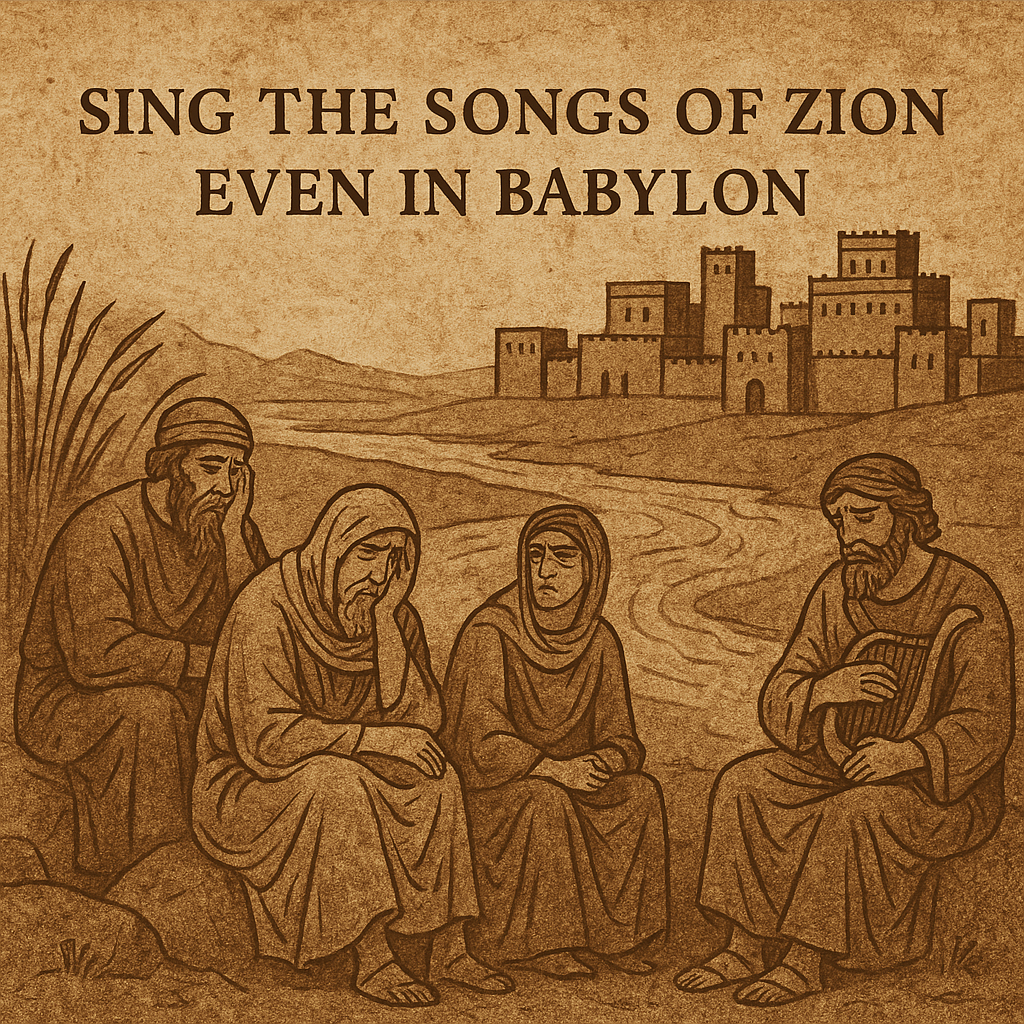
Psalm 137 captures one of the darkest moments in Israel’s history. In 586 BCE, the Babylonian army led by King Nebuchadnezzar invaded Jerusalem, destroyed the temple, the center of Jewish worship, and exiled a large portion of the population to Babylon (2 Kings 25:8–11). For the Israelites, this wasn’t just a military defeat. It was the collapse of their spiritual, national, and cultural identity. Psalm 137 gives us a raw, emotional response to that trauma: “By the rivers of Babylon we sat and wept when we remembered Zion” (Psalm 137:1).
This psalm reflects life in exile, disoriented, displaced, and disheartened. Their captors demanded entertainment: “Sing us one of the songs of Zion!” (v. 3). But the Israelites responded, “How can we sing the Lord’s song in a foreign land?” (v. 4). They could not imagine praising God in a place of pain. And yet, that was exactly what they needed to do.
God had not changed. Even though the temple was gone, He remained the same faithful covenant-keeping God. The silence of the exiles was understandable, but it missed a powerful opportunity to declare God’s faithfulness in the face of disaster. Singing the songs of Zion in Babylon would have been a testimony: Our God reigns, even here.
Scripture is filled with people who praised God in crisis. When the crops failed and the future looked bleak, the prophet Habakkuk still declared, “Yet I will rejoice in the Lord” (Habakkuk 3:17–18). In Acts 16:25, Paul and Silas sang hymns while imprisoned, before their chains were broken. In Daniel 3, Shadrach, Meshach, and Abednego trusted God even if He didn’t rescue them. These examples are not just inspirational, they are instructional.
Thanksgiving in exile is an act of faith. It’s how we declare that our hope isn’t tied to place, power, or peace but to a God who never forsakes His people. Zion’s songs are not merely nostalgic memories. They carry promises. They remind us of who God is, what He has done, and what He will yet do.
Psalm 137 also tells us something about trauma. The Israelites couldn’t sing because their grief was real. But as time passed, God reminded them through prophets like Jeremiah that exile was not the end: “I know the plans I have for you,” declares the Lord, “plans to give you a future and a hope” (Jeremiah 29:11). God promised that after seventy years, He would bring them back (Jeremiah 29:10). The prophet Isaiah told them, “When you pass through the waters, I will be with you” (Isaiah 43:2). Babylon was a chapter—not the conclusion.
You may find yourself in your own form of exile today. Life may not look like what you planned. You may feel far from what’s familiar. But even in that place, God is still worthy of your song.
So, what song have you stopped singing?
What praise have you silenced because of pain?
Don’t wait for things to change before you give thanks. Give thanks because God does not change. Praise is not just celebration, it’s resistance. It’s spiritual warfare. When you sing in exile, you declare: “My God is still with me, and I will trust Him here.”
As Psalm 34:1 says, “I will bless the Lord at all times; His praise shall continually be in my mouth.” That includes Babylon. That includes suffering. That includes now.
Prayer:
Lord, give me the strength to sing, even in hard places.
Help me remember that exile is not abandonment.
Let my thanksgiving rise, because You are always faithful.
Amen.