

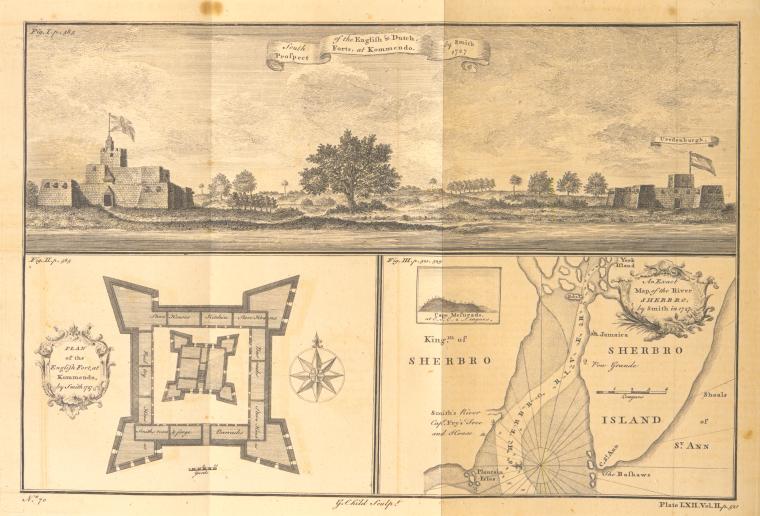
I was born in a small village near Sekondi, and I live in Amsterdam now, but my family story also runs through a coastline place many people have never heard of: a very small community once called Dutch Komenda.
That name is not a metaphor. It points to a real European footprint on the Central Region coast, with real stone, real guns, and real commercial intent.
Why “Dutch Komenda” existed
Komenda sat in a strategic place on the Gold Coast. European companies were competing for control of trade routes, coastal access, and alliances with local authorities. By the late 1600s, Komenda became one of the flashpoints of that rivalry, with shifting coalitions involving Dutch, English, Danish, Brandenburg, and French traders, plus the politics of Eguafo and neighboring powers.
The Dutch presence in Komenda is closely tied to one structure: Fort Vredenburgh.
Fort Vredenburgh and the logic of the fort

Fort Vredenburgh was built by the Dutch in 1682 on the left bank of the Komenda River, in the area that became known as Dutch Komenda. The fort was not built for curiosity or tourism. It was built to protect a trading position, enforce leverage, and signal that the Dutch were not leaving.
And the Dutch were not alone.
Within cannon-shot distance, the English constructed Fort Komenda in the 1690s, expanding on an earlier English trading post that existed there in the 1600s (Wikipedia, Fort Komenda, n.d.). Two European forts, placed so close they could threaten each other directly, tells you what Komenda had become: contested ground.
This rivalry spilled into open conflict. Around the turn of the 18th century, Komenda was a center of the Komenda Wars, involving Dutch and English forces and their local allies, and shaped by figures such as the local trader John Cabess (Wikipedia, Fort Vredenburgh, n.d.).

Whatever language people prefer, trade, diplomacy, “alliances”, the baseline is this: Komenda was pulled into an Atlantic system where European profit depended on control, coercion, and violence.
Slave trade memory in the stones
These forts are part of the wider network of “Forts and Castles” in Ghana that UNESCO inscribed as World Heritage in 1979, explicitly tied to European colonial influence and the Atlantic slave trade (Wikipedia, Fort Vredenburgh, n.d.).
Even when a fort’s primary function shifted over time between gold, commodities, and human beings, the architecture served the same purpose: extraction and confinement. Fort Komenda is repeatedly discussed as having been used in the slave trade, with captives held before shipment across the Atlantic (Cape Coast Castle Museum, n.d.).
That history is not abstract to me. It sits inside the name Dutch Komenda, inside the ruins, inside family memory that is often carried without public language.
The transfer, the resistance, and the cost
There is another layer that matters for understanding local anger and distrust.
In 1868, Fort Komenda was transferred to the Dutch as part of a broader exchange of forts between Britain and the Netherlands. The local population resisted that transfer, force was used, and conflict followed, with an expedition and battle recorded in the historical account. Within a few years, the Dutch Gold Coast itself was transferred to the UK by treaty in 1871, effective 1872 (Wikipedia, Fort Komenda, n.d.).
So even late in the timeline, local people were not passive objects being moved around. They resisted. They paid for it.
Where the story becomes uncomfortable for Europe
Many Dutch people in Amsterdam know the big locations: Elmina, Cape Coast, sometimes Suriname, sometimes Curaçao. Komenda is rarely mentioned. Yet Komenda carries the same imprint, and in some ways it shows the pattern more clearly: take value, build control, leave ruins, and move on.
If the moral claim is “we remember”, then memory without material responsibility becomes performance.
The present reality, and the silence built into underdevelopment
When a place is small and under-resourced, it becomes easy to ignore. No major museums. No steady flow of visitors. Limited political pull. The ruins remain, but the community around them often lacks basic infrastructure and investment at the scale needed.
Even official local planning documents talk about raising living standards through better access to basic social services and infrastructure, and creating conditions for economic growth (Ministry of Finance, Ghana, 2024). Academic work on the area also points to the challenges local government faces in turning tourism and heritage into development outcomes for communities (Wageningen University Repository, n.d.).
This is the part people skip: heritage sites do not feed families by themselves. If heritage is monetized anywhere, it should first stabilize the lives of the people who live next to the ruins.
The reparations question, without slogans
Here is the core issue I want to put on the table.
Slave trade wealth helped finance institutions, ports, merchant families, and state capacity in Europe, including the Netherlands. The physical proof of that system still stands in Ghana, but many of the communities tied to it remain under-invested, and the benefits rarely circle back in a serious way.
So the question is not only, “Do we acknowledge the past?”
The question is, “What does repair look like in places that have no voice?”
Repair is not a guilt ritual. It is policy, funding, conservation work, education, and targeted development, designed with local leadership, not imposed as charity.
If the Netherlands can fund restoration projects, memorials, and research, it can also fund community-linked investment tied to specific sites and specific histories. If we can name Dutch Komenda, we can also decide that it should not be left to decay with the people who live there.

What I am asking for
- Put Komenda on the map in Dutch conversations about slavery and colonialism, not only the famous forts.
- Support Ghana-led preservation and education around Fort Vredenburgh and Fort Komenda, with transparent local benefit.
- Pair heritage funding with basic infrastructure support in the surrounding community, so “memory” has economic weight.
- Treat reparations as practical repair, not as a debate club topic.
If you live in the Netherlands and care about the slavery story, do not stop at what is easy to visit or easy to post. Look for the places that are small enough to be ignored. That is where the system shows its real shape.
Bibliography
- Wikipedia. Fort Vredenburgh. n.d.
- Wikipedia. Fort Komenda. n.d.
- Cape Coast Castle Museum. Fort Komenda. n.d.
- Ministry of Finance, Ghana. Komenda–Edina–Eguafo–Abrem Municipal Composite Budget 2024. 2024.
- Wageningen University & Research Repository. Tourism and Local Development in KEEA. n.d.
Leave a Reply