

Introduction
For generations, Christians have wrestled with the question: Can faith in God and trust in science go hand in hand? In an age of artificial intelligence, medical breakthroughs, and space exploration, this question becomes even more pressing. Some believers feel they must choose between their faith and scientific reasoning. Others see science as a threat to spiritual truths. But is this divide real—or necessary?
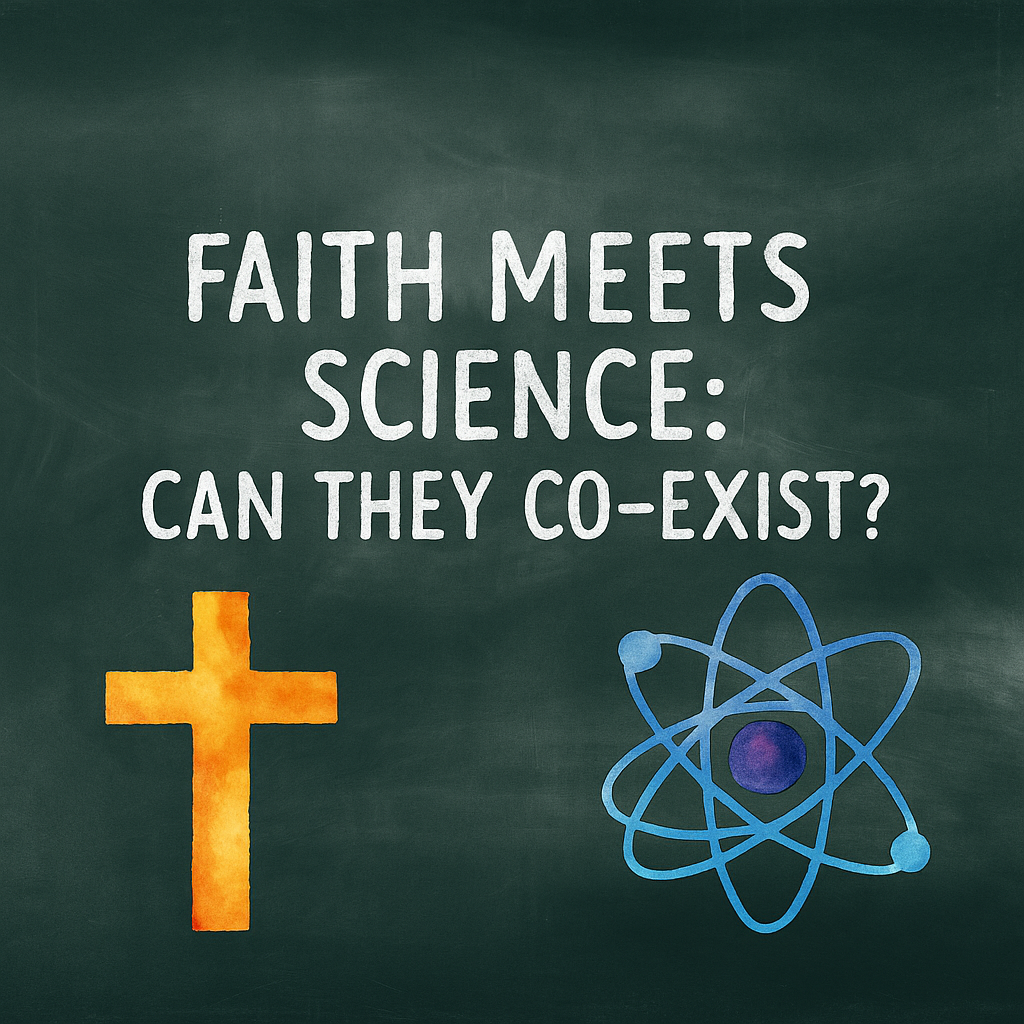
This blog explores how Christian faith and science can not only co-exist but also complement each other. We will consider historical examples, theological insights, and scientific evidence that point not away from God, but toward Him.
Faith and Science: Historical Harmony
Contrary to popular belief, the so-called war between science and religion is a relatively modern idea. In fact, many of the pioneers of science were devout Christians. Isaac Newton, widely regarded as one of the greatest scientists in history, wrote more about theology than he did about physics. Johannes Kepler, who developed the laws of planetary motion, said he was “thinking God’s thoughts after Him.”
Historian Peter Harrison notes that the scientific revolution was shaped by theological thinking. Early scientists believed that because God created the universe, it was worth studying, and that creation reflected divine order (Harrison, The Territories of Science and Religion, 2015).
These examples show that faith and science can serve as allies in our quest to understand the world.
Where the Conflict Emerged
The perceived tension between Christianity and science intensified in the 19th and 20th centuries. The publication of Charles Darwin’s On the Origin of Species (1859) sparked major debates about creation and evolution. For some, Darwin’s theory challenged the biblical creation account in Genesis.
However, not all Christians reject evolutionary theory. Theologian B.B. Warfield, a staunch defender of biblical authority, was open to the possibility that God used evolution as a tool for creation. More recently, scholars like Francis Collins, a devout Christian and former head of the Human Genome Project, affirm both evolutionary science and the belief in a Creator.
Much of the modern conflict stems from misunderstandings, both of Scripture and scientific method. The Bible is not a science textbook, but a spiritual guide. Science, on the other hand, studies how the world works, but cannot answer why it exists or who designed it.
Can a Christian Believe in Science?
Absolutely. Faith and science address different types of questions. Science asks: “How does this work?” Faith asks: “Why are we here? What is our purpose?”
Christians can celebrate scientific progress as a reflection of God’s creativity. Psalm 19:1 declares, “The heavens declare the glory of God; the skies proclaim the work of his hands.” When we explore the laws of nature, we are discovering more about the One who wrote those laws.
Medical advancements, for example, are a gift from God when they bring healing. Technology can help spread the Gospel to places never reached before. Even artificial intelligence, when guided by ethics and Scripture, can serve kingdom purposes.
It’s not science that threatens faith; it’s the idea that science can explain away everything, including God. That’s not science, but scientism—an ideology that claims only empirical data matters.
Living With Both Faith and Reason
Jesus taught his followers to love God with all their heart, soul, and mind (Matthew 22:37). This includes engaging with science and the world God made. Christianity is not anti-intellectual; it invites exploration, curiosity, and awe.
As Christians, we must avoid two extremes. One is to reject science entirely and fall into fear or conspiracy thinking. The other is to abandon our faith in favor of secularism and scientific absolutism. Neither path leads to truth.
Instead, we can live in the tension, trusting the Word of God while appreciating the discoveries of science. These are not enemies, but partners in revealing the fullness of God’s design.
Final Thoughts
Faith and science are not at war. They are different lenses for understanding the same universe. Christians don’t need to fear science. When rightly understood, it points to a Creator who is not only powerful but wise.
God is not threatened by the microscope, the telescope, or the laboratory. He made all things and invites us to explore them with wonder, humility, and faith.
Bibliography
- Harrison, Peter. The Territories of Science and Religion. University of Chicago Press, 2015.
- Collins, Francis S. The Language of God: A Scientist Presents Evidence for Belief. Free Press, 2006.
- McGrath, Alister. Science and Religion: A New Introduction. Wiley-Blackwell, 2010.
- Numbers, Ronald. Galileo Goes to Jail and Other Myths About Science and Religion. Harvard University Press, 2009.