

Introduction
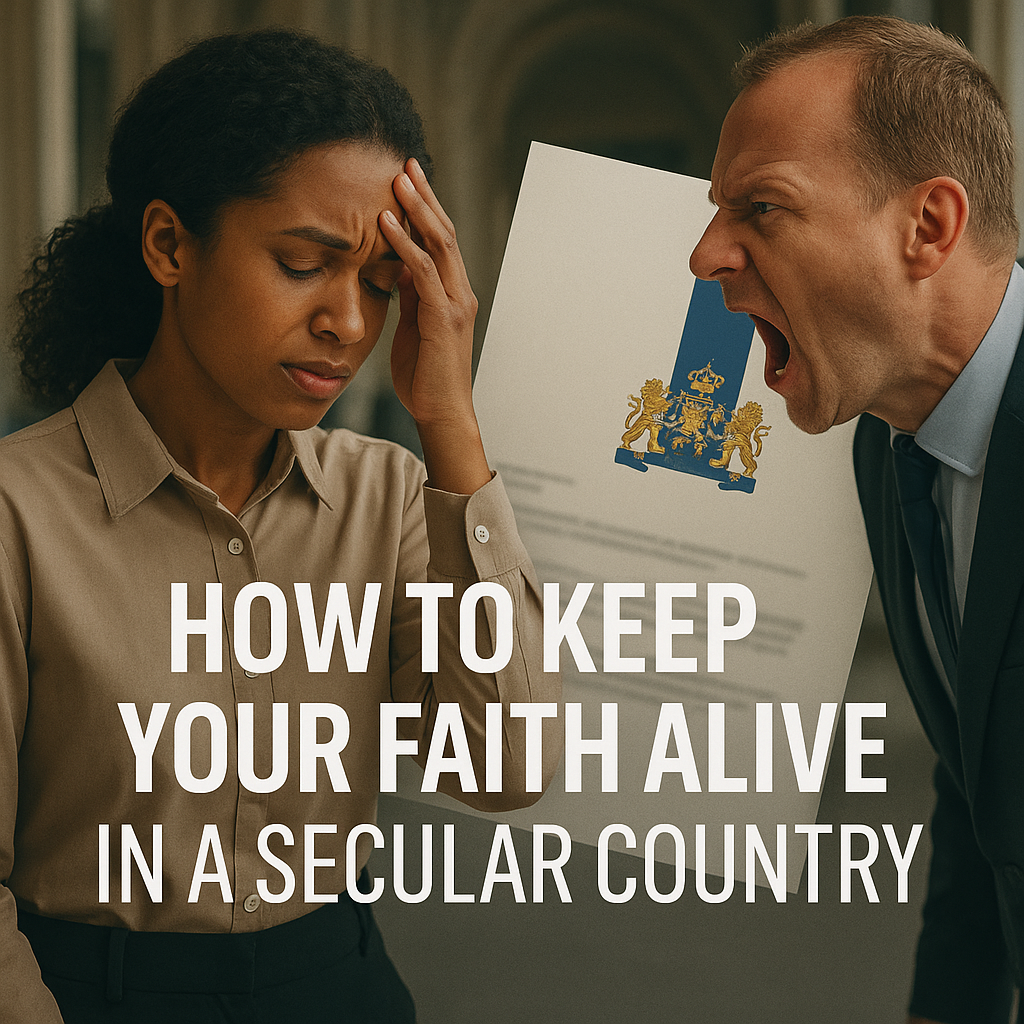
A sister from church once shared a story that deeply troubled and challenged me. She had just finished a long day at work and was reflecting on a recent incident that left her shaken. As part of her normal conversation, she often greeted her colleagues with phrases such as, “By the grace of God, I’m fine,” or closed conversations with “Thank you, God bless you,” and occasionally said, “God willing, tomorrow.” For many of us from Ghanaian backgrounds, this is simply part of our culture. These phrases are not meant to convert, provoke, or even preach—they are part of how we express gratitude, humility, and faith in daily life.
But to her Dutch colleagues, these everyday statements were seen as problematic. Her supervisor reported her for proselytizing at work, accusing her of trying to convert others. The matter was even escalated to her recruitment agency. She was stunned. What she saw as ordinary expressions of faith were received as threats in a secular environment. She wasn’t preaching a sermon. She was simply speaking from her heart. This story is not unique. It represents a larger tension that many believers face in secular societies like the Netherlands.
How, then, do we live out our faith openly, confidently, and respectfully in cultures that prefer faith to be hidden?
Faith Is Meant to Be Lived, Not Hidden
In Matthew 5:14–16, Jesus tells His followers, “You are the light of the world. A town built on a hill cannot be hidden.” He doesn’t say we are the light of the church, but the light of the world. That distinction matters. Faith was never meant to be kept behind closed doors. It was always meant to be visible, active, and public.
In highly secularized nations like the Netherlands, however, public expressions of faith can be perceived as intrusive or inappropriate. Historian James Kennedy notes that Dutch secularization intensified especially after the 1960s, as church membership declined and religion began to retreat from public life. He writes, “Religion did not vanish, but it became more individualized and privatized, less a matter of public concern and more an issue of personal choice.” — Building New Babylon, p. 183.
In this cultural atmosphere, people of faith face the challenge of balancing authenticity with sensitivity. Yet we must remember that shrinking our light does not honor God. Romans 1:16 boldly declares, “I am not ashamed of the gospel, for it is the power of God that brings salvation.” If our faith is truly part of our identity, then it must show—even in secular spaces.
Understand the Culture, But Don’t Bow to It
It’s important to understand the culture we live in. Dutch society values privacy, individualism, and freedom from religious influence. In workplaces, religion is often considered inappropriate or even offensive. A 2019 report by the SCP (Sociaal en Cultureel Planbureau) showed that over 50% of Dutch citizens identified as non-religious, with younger generations showing even higher rates of secularism.
However, cultural understanding must not lead to cultural conformity. Consider Daniel in Babylon. He served in a hostile, pagan regime yet maintained his spiritual disciplines. He prayed openly, lived with integrity, and never compromised his devotion to God. In Daniel 6, we see him praying three times a day, knowing it could cost him everything. Yet his loyalty to God remained.
Like Daniel, we are called to be in the world, but not of it. We must respect workplace norms and national laws, but we should never be pressured into silence. The key is courage with wisdom.
Speak the Language of Love, Not Just Religion
One reason faith-language may cause discomfort is that many people no longer understand it. When someone hears “God bless you,” they may associate it with religious institutions they mistrust or experiences they’ve found oppressive. The goal, then, is not to stop speaking our faith, but to explain and live it with love.
1 Peter 3:15 offers this guidance: “Always be prepared to give an answer to everyone who asks you to give the reason for the hope that you have. But do this with gentleness and respect.” These two values—gentleness and respect—are key to witness in secular societies. People may not agree with you, but they can respect you if your life reflects grace, compassion, and consistency.
The sister who shared her story didn’t shout her faith. She simply lived it. And that quiet, faithful presence often speaks louder than any sermon.
When You Face Opposition, Don’t Back Down
Faithfulness is costly. Jesus warned us of this. In John 15:18–19, He said, “If the world hates you, keep in mind that it hated me first… you do not belong to the world, but I have chosen you out of the world.”
When the sister was reported, she felt humiliated. Should she stop saying “God bless you”? Should she silence herself to avoid another complaint? But after prayer and wise counsel, she decided not to change her language. She wasn’t trying to convert anyone, she was just being herself.
Opposition is not new to believers. What matters is how we respond. If we compromise every time we’re challenged, our witness becomes diluted. But if we remain respectful, loving, and unashamed, we show the world what true conviction looks like.
Practical Ways to Keep Your Faith Alive
Pray for discernment. Ask God for wisdom in navigating your workplace, school, or community. Not every battle is worth fighting—but some are.
Speak naturally. Use phrases that feel authentic to you, but also be ready to explain them if someone asks.
Live with integrity. Your life is the loudest sermon. Be kind. Be dependable. Be excellent. Let people see your faith before they hear it.
Build community. Stay connected to fellow believers. Isolation leads to fear. Fellowship fuels courage.
Read the Word. In secular spaces, God’s voice can feel distant. Scripture keeps your spirit rooted.
Be gracious under fire. If you face criticism, respond with humility, not defensiveness. Remember, we represent Jesus in every reaction.
Final Thoughts
Living as a believer in a secular country is not easy. But it is not impossible. The Netherlands may be post-Christian in many ways, but the Gospel has never needed cultural approval to thrive. It only needs faithful people willing to live boldly and wisely.
If a simple phrase like “God bless you” causes friction, perhaps it is because the Spirit is still working. Maybe your quiet witness is stirring something deeper in others.
So keep the fire burning. Speak truth with love. Don’t hide who you are. You don’t need a pulpit to be a preacher. Your life is already speaking. Let it say something worth hearing.
Bibliography
- Becker, Jos, and Joep de Hart. Godsdienstige veranderingen in Nederland: Verschuivingen in de binding met de kerken en de christelijke traditie. SCP, 2006.
- Kennedy, James C. Building New Babylon: Cultural Change in the Netherlands during the 1960s. Eerdmans, 2005.
- Sociaal en Cultureel Planbureau (SCP). Religion in the Netherlands: Key Figures 2019. https://www.scp.nl
- The Holy Bible, New International Version (NIV).